|
They flew when 'even the birds were walking' By Chris Must, Perth
EMC EMC Lifestyle Gurneys service in a meterological reconnaissance squadron flying missions over the Bay of Biscay led him to be invited many years later to help research a book on the subject, titled Even the Birds Were Walking. Today Gurney is long retired, following a 27-year military career including a stint as an intelligence analyst with expertise in electronic warfare followed by seven years with a management consulting firm, and 10 years as head of human resources for the CBCs English network. He has donated his extensive collection of reference books on the navy and air force to the library at Royal Canadian Legion Branch 244 Hall of Remembrance museum. These people care, said Gurney of the museum volunteers. These guys are doing a great job. Im very happy and pleased that my books are going somewhere. With Gurneys donation of 500 books and two cabinets to help display them, museum curator Gordon Thomas said the Hall of Remembrance now has a library of close to 5,000 books. We are going to have, I think, one of the most complete collections of military history, from the Napoleonic Wars right up to date, said Thomas. Gurneys collection, he added, is going to be kept separate. The Legion is hoping the library will be a valuable research facility for genealogists, students, and people involved in any type of military research. All kids wanted
to fly Gurney had developed an ear infection that damaged his eardrums, and was advised by a doctor to wait six months to allow them to heal completely; otherwise the air force might reject him. The six months passed, and he joined. He had tried twice before, but been sent home because he was only 17. Recruits younger than 18 could enlist if their parents signed a release form, but Gurneys parents had refused to do so. It was fashionable for all kids to want to fly in those days, Gurney recalled. When the war came that was our chance to go flying. It was a lot more dangerous than most of us thought it would be. When Gurney joined on March 10, 1942, he was given one days pay $1.30 then went on unpaid leave until April. At the end of the leave he reported along with thousands of others to the manning depot at the Toronto Exhibition grounds, which had been taken over the by the army and air force for the duration of the war. Following basic training at the depot, Gurney was part of a group of 126 recruits chosen to form an elite precision drill squad to help with recruiting. Their sergeant was George Richards, a former professional wrestler. Gurney recalled that Richards was A gruff looking guy, but a pussycat. He looked after us like a father. This was the same George Richards who founded the chain of mens big and tall clothing stores still operating more than 60 years later. After several more weeks of training, including a bombing and gunnery school located in Jarvis, Ontario, Gurney was chosen to be an observer. My depth perception wasnt good, so they didnt want me to be a pilot. The role of observer in a Halifax heavy bomber was a combination of bomb aimer, gunner, and navigator. Richards group completed further training at Chatham, New Brunswick, and Summerside, PEI, then shipped out to England, arriving on Sept. 16, 1943. Gurney had turned 20 the day before. Gurneys assignment would be with Coastal Command, and his first stop was a small island in the Hebrides off the west coast of Scotland. Although there were six Canadian squadrons in Coastal Command, Gurney ended up with a British Royal Air Force squadron in Wales. His final six weeks of training were in the actual Halifax bombers the squadron would be using to fly its missions. Then you knew what you were learning was very important, he said. The squadrons mission was weather reconnaissance over the Atlantic, specifically the Bay of Biscay. The entire eastern half of the North Atlantic was reconnoitred twice a day, every day to gather weather information that would be of vital importance in the final decision of when to launch the D-Day invasion in June of 1944. The reconnaissance flights lasted for over 10 hours, and were flown in all weather. While in England Gurney met his future wife, Audrey, who served as an air raid warden in London during the war. The couple decided to get married, but would wait until the war was over.
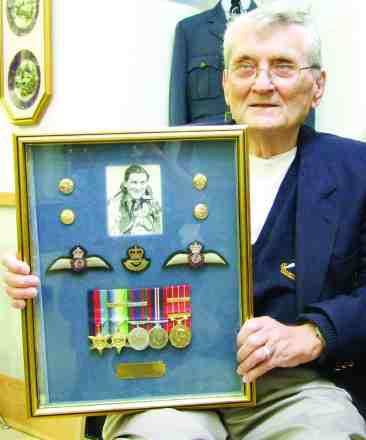
Photo by CHRIS MUST Air force veteran Bob Gurney's medals are mounted in this display, along with a wartime photograph. He is donating this memorabilia to the Branch 244 Hall of Remembrance Museum, along with a collection of about 500 reference books. Part of Gurneys role as observer in his Halifax aircraft was manning the beam guns located at the side of the fuselage. That was my job if we were looking for a fight, he said. Heavy bomber aircraft normally didnt go looking for a fight, except on one memorable occasion. The weather reconnaissance Halifax went out fully loaded in case it encountered any enemy submarines or fighters. On Aug. 13, 1944 the aircrew were on a flight that would take them 600 miles out over the Bay of Biscay. Every 200 miles they took the Halifax down to 50 feet to measure sea level atmospheric pressure. Its no fun going down to 50 feet when there are 40-foot waves, Gurney observes. On the way down during this one trip we came down through a cloud, and out in front of us was an airplane, said Gurney. The captain thought it looked like a German plane, and another member of the crew confirmed that it was a Messerschmitt Me 410, built for coastal reconnaissance and probably unarmed. We were up above him, and he supposedly had no guns, said Gurney. The captain said, lets attack him. Gurney had his beam guns ready. But the German must have had a warning detector in the tail of his aircraft, and he quickly turned and headed back to France. The Halifax crew lost the chance of shooting him down, but also escaped being shot down themselves if the German had turned out to be armed after all. It wasnt a heroic act, and it wasnt a smart act, Gurney says today. It was stupid. The Germans withdrew from northern France the following day, and no longer flew over the Bay of Biscay. Only one other member of the eight-man crew Gurney flew with in Halifaxes still survives: co-pilot Lars Lou Christofferson. At the end of the war Gurney was offered a permanent officers commission in the Royal Canadian Airforce. Today he isnt sure exactly why, but he suspects it was his initative in working out the complex mathematics needed to design from scratch a chart used to operated the new LORAN long range navigation system. His career with the RCAF lasted until 1968, and included five years of intelligence work. He also served at the Staff College in Toronto, in charge of resourcing, before retiring in 1968. Everything Ive done has been a wonderful learning experience, said Gurney. He and his wife Audrey moved to Perth from their previous home in Dunrobin four years ago. Ive been very, very happy here in Perth, he said. The people are just great. Air force veteran Bob Gurneys medals are mounted in this display, along with a wartime photograph. He is donating this memorabilia to the Branch 244 Hall of Remembrance Museum, along with a collection of about 500 reference books." |