|
Medals at Perth Legion commemorate Fenian Raids By Chris Must, Perth
EMC EMC Lifestyle The Battle of Ridgeway was little more than a skirmish, fought by about 650 raiders from the Fenian Brotherhood, against 850 Canadian militia, and resulted in just a handful of casualties. It was however, the largest engagement of the Fenian Raids, a series of incursions into Canada which offer some disturbing parallels to modern terrorist movements. The Fenian Brotherhood was formed in Ireland in 1858, with the objective of forcing Great Britain to relinquish control of the Emerald Isle and allowing the creation of an Irish republic. An American branch of the brotherhood was formed, and its leader conceived what today seems like a crazy scheme. The brotherhood would conquer Canada and hold her hostage and Britain allowed Ireland to become a republic. The New York-based Fenian Brotherhood took advantage of the abundant supply of weapons in the United States after the recently concluded Civil War, and of the ample number of unemployed young men who had emerged from that conflict with military training. Many were more than willing to put their recent experience to further use by liberating Mother Ireland. A ragtag army began to assemble on the shore of the Niagara River during the last weeks of May 1866. Both the American and British authorities were aware of what was going on. The U.S. made only half-hearted attempts to attempt the Fenians from crossing the Niagara River into Canada, in part because of persistent feelings of hostility over Britains failure to take a strong stand against the Confederacy during the Civil War which had just ended the previous year. Meanwhile Premier John A. Macdonald called out the Canadian militia: The green-uniformed Queens Own Rifles, the red-coated 13th Battalion from Hamilton, and two local companies from Caledonia and York. On June 1 the residents of Fort Erie awakened to the sight of the raiders, calling themselves the Irish Republican Army, who had crossed the river flying a green flag decorated with a golden harp and crown. The Fenians had brought extra arms and uniforms, and they invited the Canadians to join them in their mission to rid Canada from what they called British tyranny, but found no takers. The invading force numbered about 1,000, led by Union army veteran Brigadier General John ONeill, a native of Ireland. The Fenians left a small force at Fort Erie and set out to meet the columns of militia heading in their direction. They marched across Black Creek through a cedar swamp, then turned inland on Ridge Road on the morning of June 2 to take up a defensive position on Limestone Ridge near the town of Ridgeway. The Canadian militia, poorly trained and led by an equally inexperienced and nervous commander, Lieutenant Colonel Alfred Booker, arrived at Ridgeway by train, and moved off up the Ridge Road at 7:30 a.m. with 35 rounds of ammunition each. The opposing forces made contact, and the battle began. The Canadians expended their ammunition without inflicting much damage. The Fenians were aware that a larger force of British regulars was approaching from the north, and decided to fall back to north Erie to escape encirclement. Confusion followed when a militia bugler for some reason sounded the retreat, and the Canadians also began to withdraw. Booker threw his forces into further confusion by ordering them to form a square to defend against cavalry in fact, just a handful of mounted Fenian scouts. Seeing that the Canadians were in disorder, the Fenians returned to the attack and drove the militia from the field with a bayonet charge. Militiaman Arthur James Moodie Tenny later wrote: My company when passing through an orchard heard the cry Prepare for cavalry. We formed square when several were shot. The bugle then sounded the Retire when returned to the reserve which had formed square to receive cavalry. Oh, that awful Square! Men falling all around us thick and fast with no chance to protect themselves. Nine Canadians were
killed and 37 wounded, versus Fenian casualties of four to six
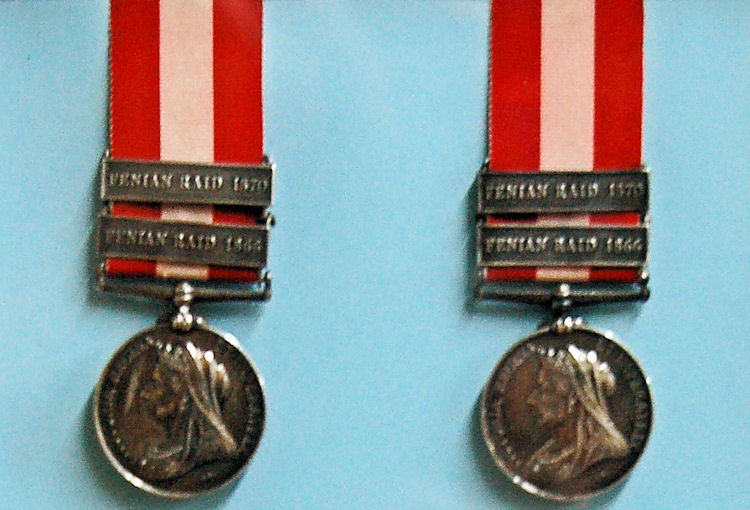
killed and 10 wounded. Despite winning the day, the Fenians realized they were about to be overwhelmed by British reinforcements and quickly returned to Fort Erie, where they won another skirmish against an outnumbered volunteer artillery battery and a naval brigade. They crossed the Niagara River back to the U.S. during the night, and surrendered their weapons to the American authorities. The U.S. government ordered the army to arrest anyone who looked like a Fenian, and to prevent any more border crossings. Since the Queens Own Rifles have been continuously active in the Canadian military since 1860, its members were were killed and wounded at Ridgeway can be considered the first casualties of the Canadian Army, even though it was not formally established as such until 1883. In 1870, Fenian raiders crossed into Quebec from Vermont, in another raid ending with the Battle of Eccles Hill on May 25, 1870. The Fenians were once again driven out, this time with no Canadian casualties. Support for the Fenian Brotherhood's invasion of Canada leveled out and there was no real threat of any more raids after the 1890s. The raids, however, did have a large effect on Canada-U.S. relations for years after the last raid. Clearly, President Andrew Johnsons government could have done more to prevent the raids. From 1866 to 1870 the Canadian General Service Medal was awarded to members of the Imperial and Canadian forces who had taken part in the suppression of the Fenian Raids, as well as Louis Riels Red River Rebellion in 1870. The Hall of Remembrance at the Royal Canadian Legion Branch 244 hall in Perth has two Canadian General Service Medals, which was awarded to local soldiers who served in the Fenian Raids of 1866 and 1870. The medals were awarded to Private W.H. Easton of the Merrickville Rifle Company and to Colour Sergeant James Heafer of the Princess of Wales Own Regiment. Heafers medal was donated to the Legion museum by his great grandson, Clair St. Cyr of Perth." |